.svg)

Dear Investor,
We want to begin this letter with a thank you. During the half, we completed the final closes of Square Peg Fund 6 and Opportunities Fund 3. Many of you have now backed us across multiple vintages, some of you across more than a decade. We never take that support for granted. We’re also grateful to our new local and global investors backing us for the first time. Your capital enables us to do the work we love, and we feel that responsibility deeply. Stewardship, for us, means making decisions with a long-term horizon, being transparent with you when we make mistakes, and holding ourselves to a high standard in how we invest capital and how we return it. That is the standard we will continue to hold ourselves to over the life of these funds.
In aggregate, our portfolio compounded by 30% over the last 12 months, and total realisations since inception have now passed US$1bn. The underlying growth of our aggregate portfolio excludes the impact of investment activity and realisations.
The increase was driven by strong fundamental performance across multiple vintages, spanning both our early-stage Venture funds and Opportunities funds, with many of our key contributors completing transactions at material valuation uplifts — including Airwallex (Series H), Supabase (Series F), Aidoc (Series E), Neara (Series D), Tomorrow.io (Series F), Vi (growth round), UpGuard (Series C) and Talon.One (acquired by Adyen). Including Talon.One, we had three exits and returned US$138m to investors over the last half, taking total realisations to more than US$1bn since inception.
Most of these were especially strong outcomes, with strategic acquirers and secondary buyers paying compelling valuations for these high-quality assets. The chart below highlights the significant value creation in our aggregate portfolio over the past few years.
Strong portfolio performance driving significant value creation

Note: Figures in USD. Aggregate portfolio performance includes all funds and co-investments as of 30 June 2026.
A framework for thinking about AI disruption
At Square Peg we invest in companies that are disrupting incumbents — it’s what we have done for 14 years. We love the asymmetric value creation opportunity it provides, the extraordinary talent and dedication displayed by our founders and their teams, and the value that these startups add to society. When a new technology era commences, it means that our older portfolio companies become “incumbents” and our newer AI-native portfolio companies become disruptors. This is particularly true of the AI era which has the potential to become the most consequential technology era ever.
Investing at the start of a new technology era creates a much higher level of difficulty and offers higher rewards. Having to simultaneously focus on the incumbent companies in our portfolio and the impact of AI makes our job, and the job of our peers, even more difficult. It is a task that we are approaching with enormous enthusiasm, humility and curiosity.
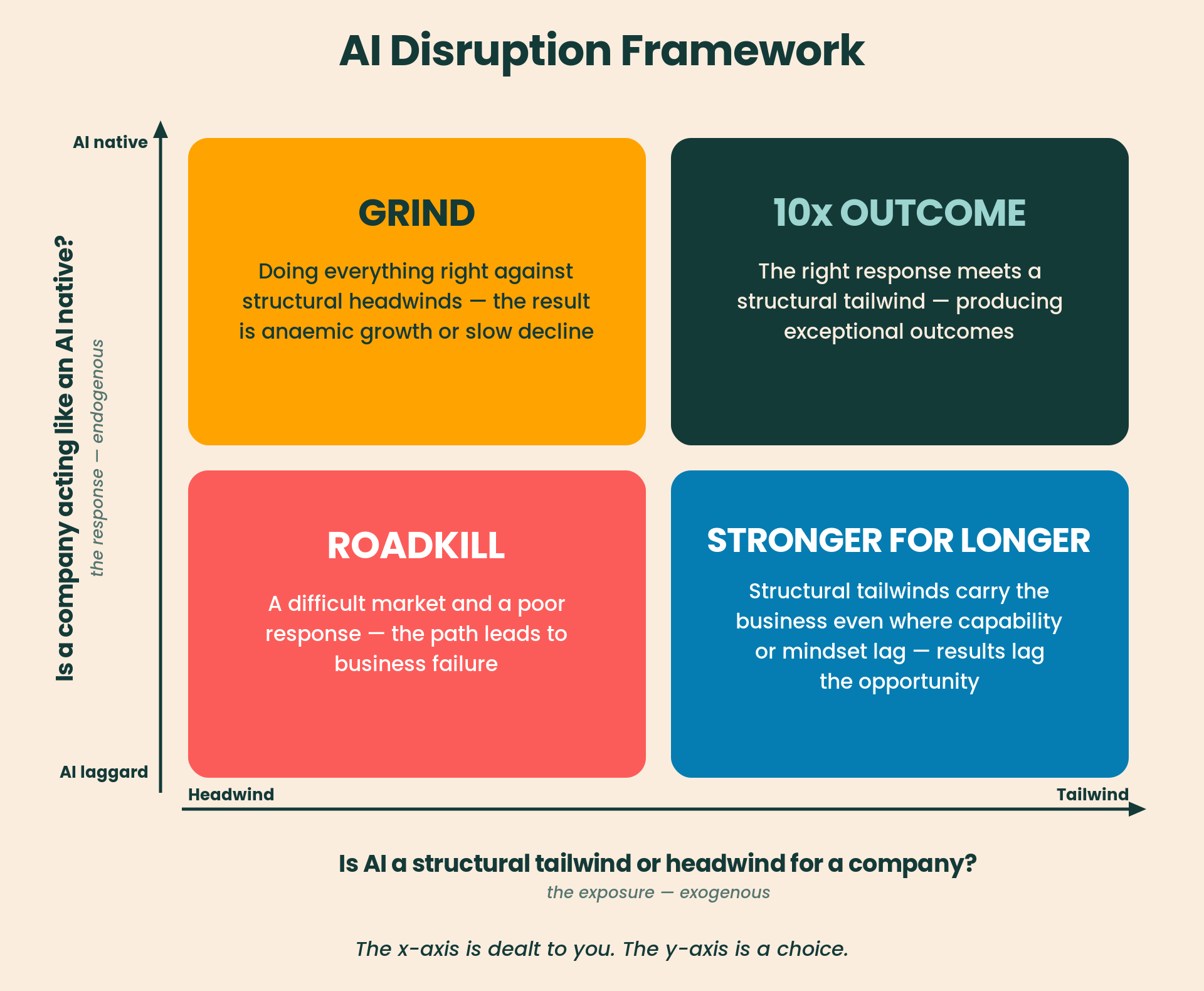
We have spent some time developing a simple framework for assessing the impact of AI on incumbent businesses. Our definition of an incumbent is simple — any business launched before ChatGPT. That makes a 2022 seed startup an incumbent as much as a 100-year-old business. The framework is built on two questions that are fundamentally different in kind:
- The first question: is AI a structural tailwind or headwind for a company? This is largely dealt to a company. The dominant driver is what AI does to the moat, and the secondary driver is what it does to the addressable market and other factors shaping market structure. We weight moat above market size deliberately — market expansion without a defensible moat just means most of the value flows to someone else.
- The second question: is a company acting like an AI native? This one is a choice. It is a function of capability and, just as importantly, mindset.
In other words, the first question is largely exogenous and the second is endogenous. A company can’t pick its exposure — but it absolutely controls its response.
History rhymes here. Streaming destroyed the distribution moat of record labels and movie studios, though other moats such as catalogues survived. The emergence of SaaS, by contrast, was a genuine tailwind for pre-cloud software businesses — it expanded the market without eroding their advantages. And legacy carmakers facing the dual disruption of EVs and autonomy show what a response failure looks like: slow to build software capability, reluctant to partner.
Put the two questions together and you get four quadrants:
- 10x outcome — right response meets structural tailwind
- Grind — doing everything right but fighting headwinds
- Stronger for longer — tailwinds carry you, but results lag the opportunity
- Roadkill — tough market, poor response
There are two implications. If you're an incumbent, you have limited control over your exposure, so your primary job is the response. If you're an AI native, you want to attack those markets where AI is a headwind for incumbents. If we go back a generation, that was exactly the opportunity for one of our founders when he co-founded SEEK in 1997. The SEEK founders didn't know how the incumbents would respond, but they knew the Internet had dealt them an awful hand.
AI Disruption Framework
Implications for our existing businesses
As you can imagine, many of the decisions we make about deploying further capital or selling down from our existing positions are informed by this framework.
On an aggregate basis we feel very excited about the growth prospects of our more established portfolio companies, the strength of their moats and, in particular, the way they have leaned in to embrace AI. The last point is critically important but also somewhat unsurprising. These are relatively young, founder-led companies with a long-term mindset and a very clear understanding of what happens to companies that embrace change, and to those that don’t.
The examples below are a few of our existing portfolio companies that we backed well before the current AI era — all of which, along with many more, have shown the capability and mindset to create substantial incremental value for their customers and shareholders.
- Airwallex: The clearest case of a moat that AI expands rather than erodes. We first backed the team in 2017, pre-product and pre-revenue. Since then it has built an 85+ market regulatory-licence stack, paired with a product organisation that ships like a software company — and it's now compounding at US$1.3bn annualised revenue (+74% YoY), with over 90% of revenue from multi-product customers. Airwallex is adopting AI as an accelerant, building on that infrastructure moat to launch AI-native software that positions its rails for the agentic economy.
- Supabase: Founded in 2020 as an open-source alternative to Google's Firebase, and has since become the default database of choice for AI agents writing software. Database launches grew ~600% over the past year, more than 60% now created by AI tools rather than human developers. A human developer picks a database once; an AI agent provisions one automatically — and increasingly it reaches for Supabase. Supabase is positioned at the centre of a structural shift in software development, and the durability of that position makes it one of our most exciting companies.
- Aidoc: Clinical AI platform whose moat comes from regulatory depth and workflow integration, rather than the AI itself. We first backed the team in 2019, when clinical AI still meant detecting one condition at a time; since then it has built CARE — the first foundation model to win FDA clearance for imaging triage — now analysing 60m+ patient cases a year across nearly 2,000 hospitals. With diagnostic error a major source of preventable harm, Aidoc is positioning itself as the default layer for deploying clinical AI at scale.
Many more portfolio companies are also leaning heavily into AI as both a growth driver and an efficiency lever. For example, Vi has accelerated revenue growth to more than 70% year-on-year, off a material base, while the company has fundamentally re-architected its internal infrastructure around AI and meaningfully reduced headcount. Similarly, Rokt continues to improve its relevance engine with AI, positioning it to benefit from AI-driven commerce — where relevancy and preserved merchant economics only grow more valuable — while also expanding margins through AI-enabled operational efficiencies. Canva, meanwhile, has attacked the AI opportunity on multiple fronts across M&A, talent and product — repositioning itself from a software design tool into an agentic creative system. These are a few examples, among many, of founder-led companies using AI as an accelerant of an existing moat.
How we are investing in this market
We are in the early stages of an extraordinary period of value creation by AI-native startups. The addressable markets that AI-native businesses are attacking dwarf the markets of previous eras. In the case of prior technology eras such as the PC era and the Internet era, the size of addressable markets was extremely small in the early years and it took many years of compounding for market leaders to reach significant scale. By contrast, AI is expanding the boundary of what software can do — from assisting work to performing it. This is also where most of our recent early-stage investments are concentrated — companies like Byron (agentic business tax), Lorikeet (customer support), Sumble (sales intelligence) and Cuttable (automated advertising agency). Each company is attacking a labour market far larger than traditional software budgets. We expect this era to produce some enormous exits, and businesses of a scale that would have been difficult to imagine a decade ago. That prize is what makes the current environment so compelling.
However, this unprecedented value creation opportunity is balanced by high failure rates and elevated entry valuations. The market is currently placing a significant premium on AI-native businesses with strong growth.
Our job is to find a handful of companies in each vintage that ultimately evolve into remarkable businesses. The valuations at which we enter and exit are of course relevant, but will have a much lower correlation with our performance than the quality of businesses we invest in. We are valuation aware but we are founder obsessed.
The advantage of investing across APAC
Our strategy of high conviction, repeatedly backing our winners and investing across multiple geographies has remained the same for over a decade. We believe the current environment underscores the benefit of our model more than at any point in our history.
The next few years will see a very high level of startup formation. The cost of building software is falling rapidly, and ambitious founders everywhere can see the size of the opportunity. More company formation will mean higher levels of failure — and larger markets mean bigger winners. In that environment, the breadth of our opportunity set matters enormously. Seeing opportunities across multiple geographies gives us a larger pool to select from, and just as importantly, it lets us pattern-match across markets. A theme we see emerging in one geography sharpens our judgement in the others.
One phenomenon we find particularly interesting is the rise of Singapore as an important global tech hub. For much of the last decade, Southeast Asian technology was largely a story of regional businesses serving regional markets. That is changing. Supabase, the largest position in our 2022 Vintage and also held across multiple Opportunities Funds, is a great example of a globally important business emerging from Singapore. More recent early-stage investments such as Octen AI and PixAI reflect the same shift. Looking ahead, we expect Singapore to produce a growing cohort of companies that are the best in the world at what they do, and we are well positioned to back them.
Thank you for your support
We believe the coming decade will produce technology companies of a scale the world has not seen before, and that a number of them will come from our corners of the world. Thanks to your support, we enter this period with fresh capital, a portfolio of companies embracing this era from a position of strength, and fourteen years of hard-won lessons. We are grateful you have trusted us with your capital, and we intend to reward that trust. There has never been a more exciting time to do the work we love.